Who needs to read this?
- If you deliver your own goods by road – such as a concrete company
- If you engage a transport company to deliver goods by road – such as Ikea
- If you receive goods transported by road – you could be a factory or a retail shop
- If you are a transport company
- If you engage owner drivers (or gig workers)
- If you transport passengers – such as a bus company (you should talk with us separately about this)
What you need to know
The Fair Work Commission (Commission) has the power to regulate supply chains in the transport industry. These can override existing commercial arrangements and contracts.
On 20 April 2026, a Road Transport Contractual Chain Order dealing with fuel price increases was made by the Commission. The Order regulates the conduct of parties in supply chains in the transport industry.
Critically, the Order impacts more than transport companies.
This is a legally enforceable instrument, just like a modern award or an enterprise agreement. Non-compliance can also attract steep penalties.
The balance of this article answers key questions about the Order:
- When does it start?
- Who does it apply to?
- What are the obligations?
- How can you adjust your rates to meet this obligation?
- How can the fuel adjustment obligations be satisfied?
- Can I keep doing what I am doing if it meets these fuel adjustment obligations?
- Can I recover the fuel cost increases up the supply chain from my customer/client?
- Are there any other obligations under the Order?
- How are people practically doing this down the supply chain?
- How are people practically doing this up the supply chain?
- How did all this happen?
We also set out two example scenarios to illustrate how the Order might impact a business in a supply chain.
Need Help?
If the changes discussed in this article raise concerns or you have questions specific to your business, our team at Australian Business Lawyers & Advisors (ABLA) are ready to assist.
You should not delay getting in touch if you:
- are uncertain about whether the Order applies to you
- are uncertain if your existing arrangement(s) satisfy the obligations of the Order
- are uncertain about what constitutes “reasonable steps” for your business.
Key Questions
1. When does it start?
The Order takes effect from Tuesday, 21 April 2026. The obligations are effective from that date – they are not retrospective.
The Order will be the subject of review by the Commission over the coming months and this will likely focus on issues such as how the Order is working, issues with fuel price increase recovery, or issues with fuel price increase gouging. ABLA will appear in these reviews and will keep you informed of any amendments.
The obligations will cease to apply if the weekly average national terminal gate price for diesel, as measured in the weekly diesel price report of the Australian Institute of Petroleum (AIP), falls below $2.00 per litre.
2. Who does it apply to?
It creates obligations on all parties in the road transport supply chain from top to bottom, including:
- If you deliver your own goods by road – such as a concrete company
- If you engage a transport company to deliver goods by road – such as Ikea
- If you receive goods transported by road – you could be a factory or a retail shop
- If you are a transport company
- If you engage owner drivers (or gig workers)
- If you transport passengers – such as a bus company.
The only part of the transport industry excluded is cash in transit industry.
3. What are the obligations?
In general terms, the primary obligation is to pay rates that cover changes in fuel costs (i.e. the increased cost of fuel) since on or about 6 March 2026 and any ongoing changes in the price of fuel.
This impacts all persons in the supply chain:
- it works down through a supply chain to an owner driver contractor (and gig worker); and
- it works up and through the supply chain to the party at the apex of the supply chain (i.e. the person with the first contract or arrangement in the contractual chain).
We include examples at the end of this article to show how this works in practice, and in turn the impact for businesses that engage “owner drivers” and “fleet owners”.
Both “rate” and “increased cost of fuel” are defined terms in the Order:
- “Rate” means the contracted, standard, ongoing or usual rate or amount paid by one person covered by this Order to another for the performance of work in the road transport industry on or before 6 March 2026, including an hourly rate, a running rate, a total amount, or any other form of payment or combination of the foregoing.
- “Increased cost of fuel” means the difference between the cost per litre for the type of fuel used to perform the relevant work in the road transport industry at any given time and the cost as it was on or before 6 March 2026.
Owner Drivers
If you engage owner drivers your obligation is to pay rates to them that cover changes in fuel costs since on or before 6 March 2026 and any ongoing changes in the price of fuel.
On an ongoing basis you must review these rates within each fortnight or twice per calendar month and adjust the rate you pay by the amount necessary to ensure you cover the increased cost of fuel.
This review is of the rate and does not change your existing pay periods or payment terms.
We use the term “owner driver” as it is the common term, but legally the term is “regulated road transport contractor” (and the legal term is what will appear in the Order).
| Regulated Road Transport Contractors are workers (not employees) who are either: Individual |
The individual performing work under the contract |
| Body corporate |
An individual who is either a director of the body corporate, or a member of the family of a director of a body corporate, and who performs work under the contract. |
| Trustee of a Trust |
An individual who is a trustee of the same trust, and performs work under the contract, whether or not the individual is a party to the contract. |
| Partnership |
An individual who is a partner in the same partnership and performs work under the contract, whether or not the individual is a party to the contract. |
Fleet Owners
If you engage a transport fleet owner (any size of transport company) your obligation is to pay rates to them that cover changes in fuel costs since on or before 6 March 2026 and any ongoing changes in the price of fuel.
On an ongoing basis you must review these rates within each fortnight or twice per calendar month and adjust the rate you pay by the amount necessary to ensure you cover the increased cost of fuel.
This review is of the rate and does not change your existing pay periods or payment terms.
4. How can you adjust your rates to meet this obligation?
You can adjust rates in a variety of ways:
- an adjustment to the rate or a component of the rate
- the introduction of a fuel increment or levy
- a direct reimbursement or offset of money expended upon the increased cost of fuel
- any combination of these
5. How can the fuel adjustment obligations be satisfied?
The fuel adjustment obligations can be satisfied by any of the following:
- adjustment of the rate in accordance with an applicable State or Territory industrial instrument which involves the application of a ‘rise and fall’ formula or cost model to account for or address recovery of the increased cost of fuel
- adjustment of the rate in accordance with the application of a ‘rise and fall’ formula, cost model or cost benchmark in an applicable collective agreement or contract to account for or address recovery of the increased cost of fuel
- an ongoing or special arrangement between persons in a road transport contractual chain which adjusts the rate in accordance with an agreed ‘rise and fall’ formula, cost model or other benchmarking methodology to account for or address recovery of the increased cost of fuel
In relation to the third option listed, the Order providers that the ‘rise and fall’ formula, cost model or benchmarking methodology may be applied in a standardised way on the basis of a reasonable averaging of the increased cost of fuel to a group of regulated road transport contractors or road transport employee-like workers engaged by a single road transport business.
6. Can I keep doing what I am doing if it meets the fuel adjustment obligations?
Yes.
Some people have operated with fuel levies or fuel rate reviews for the last month and in some cases, years. If you have already started doing this, you can continue – as long as it complies with these obligations.
7. Can I recover the fuel cost increases up the supply chain from my customer/client?
Yes.
If you are a transport company contracted to another transport company up the chain, they must also meet the fuel increase obligations for you.
If you are a transport company contracted to the party at the apex of the supply chain – which could be a retailer, a manufacturing company, a building company or even a government agency – the party at the apex must also meet the fuel increase obligations for you. See the illustrated examples below.
8. Are there any other obligations?
Yes.
Primary parties in a road transport supply chain (the apex party and the party they contract to) must take reasonable steps to ensure that transport companies (in the same supply chain), who engage owner drivers in the same supply chain, adjust the rate they pay to such owner drivers to ensure recovery of the increased cost of fuel.
Important: This additional obligation does not apply if the primary party:
- is a small business employer; and
- is not a road transport business.
9. How are people practically doing this down the supply chain?
They are:
- using existing cost and rate, rise and fall models (and likely using them more frequently)
- working out what fuel is as a proportion of total costs and then adjusting this portion of rates by changes in the AIP diesel fuel index.
In practice, what form is this taking?
Some people are adjusting cartage rates for owner drivers and fleet owners.
Some have introduced a fuel levy or surcharge for owner drivers and fleet owners.
10. How are people practically doing this up the supply chain?
They are:
- using existing cost and rate, rise and fall models (likely using them more frequently)
- working out what fuel is as a proportion of total costs and then adjusting this portion of rates by changes in the AIP diesel fuel index.
In practice, what form is this taking?
Some people are adjusting cartage rates, but most have implemented or agreed to a temporary fuel levy or surcharge.
Roughly, this is likely based on 25% to 30% of total costs adjusted by the AIP index changes.
11. How did all this happen?
On 2 April 2026, the Transport Workers’ Union of Australia (TWU) and the Australian Road Transport Industrial Organisation (ARTIO) jointly made an application for what is known as a contractual chain order to address rising fuel prices that affect owner drivers, gig workers and transport companies throughout the transport industry in Australia.
The Commission convened a Full Bench (Expert Panel) and undertook a uniquely fast hearing process starting on 8 April.
Almost all parts of the Australian business community were involved in the case.
ABLA appeared in the matter for leading transport companies, the construction materials sector and Australian Business Industrial and the NSW Business Chamber.
ABLA played the lead role in the case, undertaking most of the cross-examination of TWU and ARTIO witnesses and in leading the ‘employer’ evidence.
Last week, the Federal Government varied the Fair Work Act to allow the Commission to deal with the matter quickly and not be constrained by usual time requirements for supply chain matters.
On 10 April the Minister for Workplace Relations issued a determination declaring that the TWU/ARTIO application is an “emergency application”, which authorised the Commission to deal with the application quickly.
Given this, it was understood that the Commission was likely to issue some form of order and ABLA focused its efforts on ensuring that the order was as workable as possible for all parties in the supply chain.
ABLA was able to secure material changes through the hearing process.
Most employer parties either took a rather benign approach or simply opposed an order being made while not advancing any evidence in support.
A Decision was published on 20 April 2026, together with the Order.
How businesses in a supply chain could be impacted by the Order
We have prepared two example scenarios to illustrate how businesses in a supply chain could be impacted by the Order.
Example 1
Cummins Liquor buys soft drinks in bulk from McFills Soft Drink Co on a delivered basis.
McFills Soft Drink Co subcontracts the delivery to Big Transport Co, who in turn subcontracts the delivery to Little Transport Co.
Little Transport Co use owner drivers engaged by them to undertake the delivery.
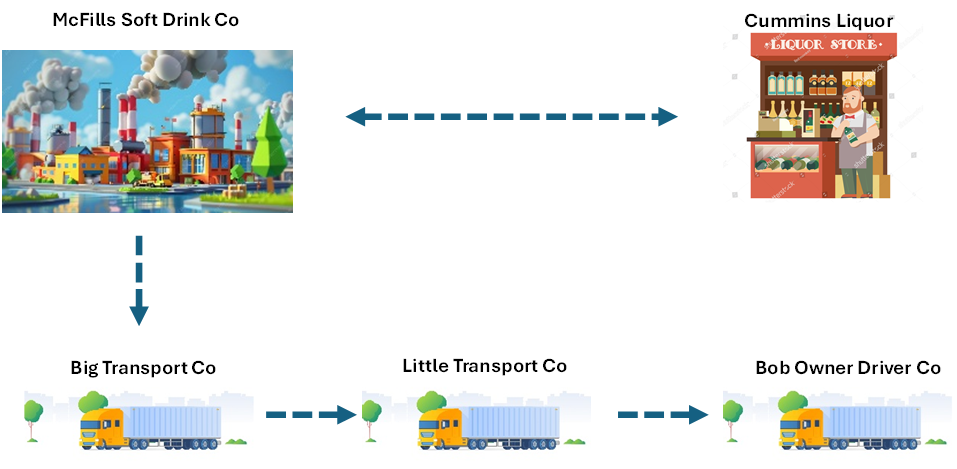
Under the Order:
- Cummins Liquor is a primary party (and would be the apex of the supply chain).
- McFills Soft Drink Co is a primary party (and would be the “other primary party, they are also a secondary party as they engage Big Transport Co).
- Big Transport Co is contracted to McFills Soft Drink Co for transport services and would be a secondary party.
- Big Transport Co subcontracts the cartage work to Little Transport Co, and this means that Big Transport Co is also a secondary party in the supply chain to them.
- Little Transport Co is also a secondary party in the supply chain.
- Bob Owner Driver Co is an owner driver who owns and drives their own vehicle (the bottom of the supply chain).
Who has to do what in the example?
- Cummins Liquor must adjust the rate they pay McFills Soft Drink Co to account for increases in fuel costs related to the cartage work performed by McFills Soft Drink Co for them.
- McFills Soft Drink Co must adjust the rate they pay Big Transport Co to account for increases in fuel costs related to the work they perform for McFills Soft Drink Co.
- Big Transport Co must adjust the rate they pay Little Transport Co to account for increases in fuel costs related to the work they perform for Big Transport Co.
- Little Transport Co must adjust the rate they pay Bob Owner Driver Co to account for increases in fuel costs related to the work they perform for Little Transport Co.
In addition:
- Cummins Liquor (as a primary party) must take reasonable steps to ensure that Little Transport Co meets its obligations to pay Bob Owner Driver Co the adjustment in rate.
- McFills Soft Drink Co (as a primary party) must take reasonable steps to ensure that Little Transport Co meets its obligations to pay Bob Owner Driver Co the adjustment in rate.
If Cummins Liquor was a small business, this additional obligation would not apply. This is because the additional obligation does not apply to a primary party that is a small business employer and which is not a road transport business.
Example 2
Cummins Liquor buys soft drinks in bulk from McFills Soft Drink Co on a delivered basis.
McFills Soft Drink Co subcontracts the delivery to Big Transport Co, who in turn subcontracts the delivery to Little Transport Co.
Little Transport Co uses its company fleet to undertake the delivery.
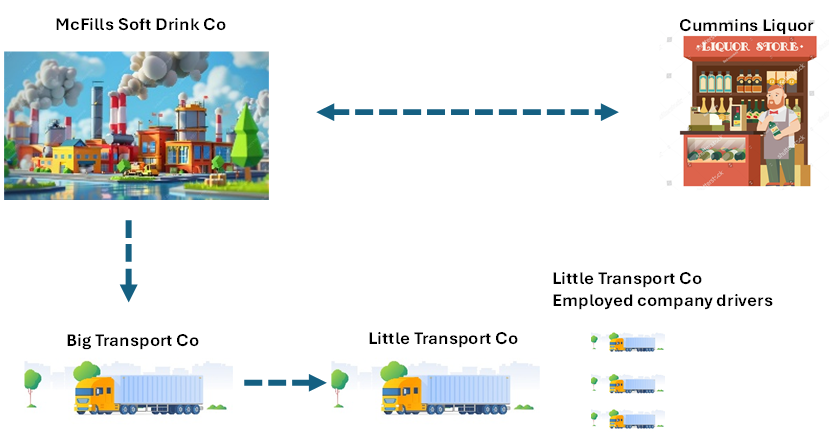 Under the Order:
- Cummins Liquor is a primary party (and would be the apex of the supply chain).
- McFills Soft Drink Co is a primary party (and would be the “other primary party, they are also a secondary party as they engage Big Transport Co).
- Big Transport Co is contracted to McFills Soft Drink Co for transport services and would be a secondary party.
- Big Transport Co subcontracts the cartage work to Little Transport Co, and this means that Big Transport Co is also a secondary party in the supply chain to them.
- Little Transport Co is also a secondary party in the supply chain and uses only their company fleet to perform the cartage work (they are also at the bottom of the supply chain).
Who has to do what in the example?
- Cummins Liquor must adjust the rate they pay McFills Soft Drink Co to account for increases in fuel costs related to the cartage work performed by McFills Soft Drink Co for them.
- McFills Soft Drink Co must adjust the rate they pay Big Transport Co to account for increases in fuel costs related to the work they performed for McFills Soft Drink Co.
- Big Transport Co must adjust the rate they pay Little Transport Co to account for increases in fuel costs related to the work they perform for Big Transport Co.
There are no additional obligations as neither Big Transport Co nor Little Transport Co are engaging owner drivers to perform the cartage work.
Have questions?
If you have any questions, please get in touch with us at info@ablawyers.com.au.